
International Year of the Woman Farmer: Pam
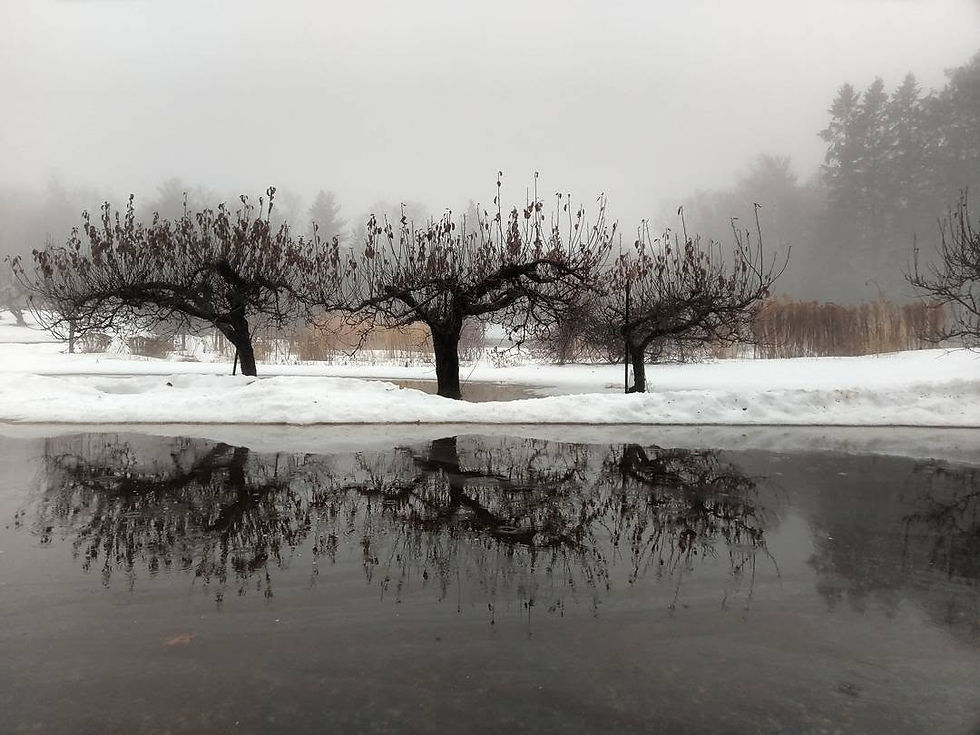
Pam is the owner of Pine Farms Orchard. Nestled in the rolling hills of King City, this 16-acre orchard was founded in the late 1940s by Pam’s grandfather, Ernie Rolph, who dedicated his retirement to pursuing his passion for gardening. Over 70 years later, the apple trees planted by Ernie are still thriving.
Pam is an avid gardener and, before running Pine Farms Orchard, she enjoyed working the land, growing gourds, flowers and vegetables. Soon, she began to prune the family apple trees as well, and the stage was set for Pine Farms Orchard's next era. Since 1998 Pam has run the operation. Her husband Elliott is now the Orchard Manager, their daughter Chloe is the Store Manager and Chloe's husband Robin is the Farm Manager.
Pam is also an incredible photographer.

What does your identity as a woman farmer mean to you?
That's a really hard one because I don't look into myself that much. I just do what I do. I guess that's really part of it is I have a job to do - to look after the people in the community, and to grow something, to be a steward of the land. It's all part of my being. I've grown up here on the farm, and I just do what I'm supposed to be doing.
I do come from a long generation of farmers, so it's an inherent thing for me to have that responsibility. As a female, taking care of the land, taking care of the people, that's another inherent sort of thing that you take on; it's the responsibility.
When the previous farmer who had taken over from my grandfather was retiring, it was really just kind of put out there. My father said, “What are we going to do? Who're we going to get to do it?” I kind of looked at it and I said, “I can do it.” It's taking on a job, and feeling confident that I can look after something and do it. To take on the legacy of what my grandfather had started. I was driving my daughter around for a tractor ride for her birthday when we had the chat. So it seemed a natural progression. I can do it.
When your grandfather was working the land, were you involved in that process with him? Did you help out?
Oh, I did, yes, absolutely.
I think I was more of a pest than anything because I was very young. I would get in the way, but I loved being here. I grew up in Toronto, and we would come up here on weekends. We had property across the road, so I would hang out here at my grandparents. I would help pick peas. I'd helped my grandmother shell peas ‘cause there was a very large vegetable garden. I ate more than I actually contributed to putting in the bags at that time, but I equate that to quality control. The same thing with the apples. We put the apples in bushel baskets and we had the big grading machine, a 1965 Bartlett grader. We still have it; we don't use it, but it is a display piece now. It does work and I used to stand at that grading machine with one of the other employees and they would be grading all the apples and packing them. I would be picking them up and eating them, and I would be playing with the stickers that went on the boxes. Lots of memories. I grew up understanding all the different parts to it, of what a six to 10-year-old could do.
Do you think that the farming and agricultural industry is designed to favour men?
Not really sure about that. Possibly. I think I'm independent enough that I would look past that. I am a farmer. I'm neither male nor female. I'm a farmer. I'm also a Taurus, so I'm a little bit bullheaded.
Maybe some things are, but if I'm with my husband, everybody always looks to him as he's the decision maker, and he always turns to me and says, “oh no, she's the boss,” you know. It's very typical for people perhaps in the farming world because there aren't a lot of women. They just look to the man as the businessperson, the decision maker, you know, that sort of thing.
I asked the question because oftentimes when someone says the word farmer, they think of a man in overalls with a straw hat and a piece of wheat sticking out of his face.
Possibly, but I wouldn't say 100% yes, because I've not had issues. I suppose if I'd had issues I would say definitely yes, right? Like if the bank isn't going to loan me money because I'm female. I haven't had that.
I'm glad you haven't had that kind of issue because that can be a very discouraging experience.
What advice would you give a younger version of yourself?
Perseverance. It is very tricky, if you're running your own business and doing your own advertising. That's a lot of elements; in farming, you are self-employed.
You're not only self-employed and building up your own business, but you have to deal with risk. You have to deal with whatever the weather is bringing you. You have that risk of losing your crop. You have constant stress. There are so many benefits if you're enjoying what you're doing: working the land. You can reap the rewards if you're good at it, and if you have luck that you're not going to have floods and frost that wipes out your crop. It's the perseverance to do it, because it can be very rewarding, and it can be devastating.
And what advice would you give a young woman who is entering into the agriculture industry?
Education and networking. Educate yourself as much as possible. And talk to as many people as you can. I found when I started, I would always go out to the grower sessions. I would go out on the bus tours, getting to know other farmers. Doing that networking, talking with people. A couple weeks ago, I went to our apple grower session in Hamilton; it's a huge long drive, but going out there, and talking, well, everybody is so helpful. In apples, we're not “competitive.” There is competition of course but everybody's always very helpful because we're all dealing with all sorts of issues. There's a young farmers group for apple growers that my son-in-law is part of, and I would say, get in with them, talk to them, because people can be so helpful. When you're in a group, if you're trying to do it on your own, and you're just forging out saying I'm going to prove something, well, that's not going to work.
There's wisdom in the community that is very helpful.
Exactly! There's a support system because you often need that support when things go haywire; and somebody can help you. We have another grower down the road. He’s had problems with his sprayer or he's had problems with his tractor, or we have issues, and it's like everybody can always lend a hand. As a young woman, you might tend to say, “oh, I don't wanna bother them,” but it's like, “No! Get out there, talk to them, because they'll help you.” They should, they better!
Would you change your advice if you were talking to an immigrant woman who was entering into the Canadian farm industry?
No, I would say even more so get out there and meet people. If you're an immigrant, you may not know what the conditions really are here. You definitely need that support system.
Is there a specific organization or group in your region that you would recommend for an immigrant woman to connect with?
I would say, York Farm Fresh, or another Farm Fresh (this was supposed to be Ontario Farm Fresh but it is now Agritourism Ontario I believe), all these ones that bring growers together, bring farmers together. If there were workshops, then you would know; being part of that group. There's always those workshops specific to an industry: if you're growing carrots and onions, or you're growing apples, there's going to be niche groups that might help.
When I was starting, it was the apple growers, and it was actually my chemical rep that said, “oh come on out. We're going to have grower sessions.” He was the one that got me into meeting people. They were fantastic.

Why is farming important to you?
It’s the family legacy. My grandfather started the farm, so I'm carrying it on. I'm looking after it, representing our family. It's a responsibility, stewardship. I know that the trees are here, I'm looking after them. Providing food for the community, that's a huge thing. I'm also providing a living for me and my husband, and my daughter, my son-in-law, and I'm providing jobs for the community. I hire a lot of young students, it's their first job. There's a lot of pride in that, not a lot of places do that. There's an education element as well that I'm very proud of as my mother was a very strong individual. She was vice dean at faculty of Arts and Science at U of T and she was a very strong woman. I learned from her, and my dad was very supportive. I've always tended towards the education side of farming so we are a working farm, we don't do entertainment. A lot of people say, “oh, you should have this and that.” No, thanks. We're not an entertainment farm. We don't do that. There's a lot of farms that have that entertainment aspect.
And yet you also partnered with a local theatre company the last couple of years.
Yes. This August will be the 3rd year which we're very, very proud to be able to support Chloe Flowers in her business, for charity.
How did that partnership come about?
Chloe actually lives in the area, she still lives around the corner. She is in the theatre world, and wanted to start up this company because she wanted to bring more culture into the area. She loved doing plays, this was her passion. She wanted to be able to offer education for students and the community, for education experience and cultural experience. She knew my daughter, Chloe, from figure skating, and she'd always come here for lattes or her teas. She thought this place would be perfect for doing open-air theatre, to kick off her play season. The porch is really good. It's like its own theatre stage. Three years ago she started that one and it was fantastic. Then last year she did “Tuesdays with Morrie”, Anything she does, whatever it is, wherever it is, it's in York region, so it's supporting York region.
What do you wish the average person understood about what it means to be specifically a woman involved in agriculture and farming.
To take us seriously. That it's actually really hard work. Possibly they think my husband does it. Getting back to that part of it, you know, “apples just grow on trees, right? Like, its nature, you don't have to do anything,” that's their attitude. “It just grows, its nature.” Yeah, right.
Oh, that's very funny.
It's getting the ones that think they should have to pay for it too because well it just grows there why do I have to pay?
Right, there's definitely an educational piece that is missing from our current system.
There was a survey from Farm Management Canada a few years ago that found a lot of women struggle with identifying themselves as a farmer. I know you've said you're a farmer, but why do you think that some women struggle with this identification?
I have no idea. Maybe the thing is that a “farmer” is a man with bushy hair and overalls. We don't identify as a farmer because they're not taken seriously, maybe.
There are some other things. I've always been very independent. I went to the Ontario College of Art and Design and I've always had my own business, that being photography. I've always been confident. I’m not saying I was good at all this stuff. I was confident enough that I could actually do it.
I think some people don't have that confidence. That's when it becomes an issue. You really have to tackle every side of it. You're not in the corporate world. It's very different. Everybody's different.
Would you say that your daughter Chloe identifies herself as a farmer?
I don't think as a farmer, no. She doesn't work the land on the farm, like planting or pruning the apple trees now - she focuses on management. She manages the store, staff and as well the social media. I don't know if she would identify as a farmer but it is a farm she manages and there are many different aspects to it so possibly yes. You would have to ask her :)
I think as a farmer, you really have to be one that does almost everything. I sprayed the trees, I did the pruning, I cut the grass. I only started bringing my husband in when I started having troubles with the mechanics. I didn't know how to fix something, and so that's when I got him to come and help.
About your husband, you say that you asked him to help, was he always a part of the farm?
No, he did renovations and additions to residential homes and small businesses. He’s quite handy when we need to have windows replaced doors fixed and cabinetry made. Now he helps with pruning, grass cutting, all the buying for the store and market. He does some the maintenance and fixing up of things. My son-in-law manages the orchard, pruning spraying, fixes all the equipment and is the IT expert.
If I'm travelling, on my passport I say I'm a retailer because I don't wanna get into the whole farming thing because then they're like, well, have you been to a farm? What boots are you wearing? I don't wanna get into that sort of stuff.
How long have you been doing the work at Pine Farms?
I took over in 1998. Yeah, almost 30.
Wow! What would you say are a couple of highlights over the last 30 years for you?
The growth of the whole store. That was always part of my vision in the beginning. When I took over, it was purely pick your own, and we were only open for a month and a half during the picking season. People would drive all the way up from Toronto to pick apples, and then they would say, “oh, do you have anything else?” That got me thinking. I had a friend Anne McLeod, who had a gift shop out of her house. I got her to come and help me learn how to buy giftware, and do all that. She was amazing at displays and merchandising. Then a neighbor and mentor Margaret Britnell, who was the former mayor of King years ago. After her work in the Township she offered to help me by baking, picking apples, and of course helping with customers. She was a very strong willed woman and was very helpful in guiding me along the way. We travelled through England and France through apple orchards, cideries and farm stores, we had a blast and it helped me understand the farm store and market possibilities I could provide back in Canada.
You don't get to be a mayor without being strong.
Exactly. So I learned a lot from her. We had 3 tables, an oven, we sold banana bread and all sorts of different pies. We also sold a little bit of giftware.
Now we're open year-round, and we have inside dining and outside dining. We do events and workshops. I guess that's really the highlight is the changes in growth and that the community are coming to enjoy peace and serenity and whatever else they need from time to time.
That's amazing. When did that start for you?
That started in 1999. So my first year was just figuring out what on earth I got myself into and the next year was adding on because the people wanted more. At that time driving out of Toronto was only a 45 minute drive, and you know it's not anymore. They wanted more, so as a businesswoman I could see that opportunity. I had 10 people working for me and now I have. Just under 50 during the apple season.
That's amazing.
I love working with my staff.
I've had so many young people work their first part time jobs here. It's so nice to see their progression in whatever paths they have taken. They come back and they say hi, it's really fun. I'm proud of that too. I'm very proud that my daughter is working with me because I see myself in her and she's a boss! She's managing the front of the house, so there's a huge sense of pride. Oh, we fight. Well, let's say we have some disagreements from time to time. But I'm proud of that because it's really, really wonderful to see what she's done with the place too. I look at her as me 25 years ago. It's wonderful.
That's amazing, that's so lovely. Must be nice for you to have not just to have taken your grandfather's legacy, but also to be passing on your own legacy.
Yes, my father still lives on the property. He's 92, and he drives around in his golf cart to check everything out. He comes in and checks on everything to make sure everything is up-to-snuff! He chats with customers and really enjoys the fact that his family has been able to carry on the family business and that makes me very happy.


This was a really inspiring read, especially the way Pam describes carrying on her family’s farming legacy while supporting the local community. Her emphasis on perseverance, education, and networking shows how much dedication goes into running a farm. It’s interesting how personal stories like this can connect very different interests, from agriculture to the unique style seen in the jacket in Blade Runner 2049.